

Electrical Panels that Florida Homeowner’s Insurance Won’t Cover
Do you own a home in South Florida that was built before 1990 and your insurance company is asking for a 4-point inspection? Or you’ve already been told your electrical panel is a problem? Florida’s insurance market has gotten brutal about old panels in the last few years. A panel that was acceptable a decade ago can now mean a non-renewal letter, a denied policy, or a premium hike that doesn’t make sense.
This guide covers the panel brands that fail 4-point inspections, the capacity ratings that won’t pass underwriting, what panel replacement actually costs in Palm Beach, Broward, and Miami-Dade County as of 2026, and what the replacement process looks like from permit to final inspection.
Quick Answer
- Replace immediately: Federal Pacific (Stab-Lok), Zinsco, Sylvania-Zinsco, Challenger, or any pre-1960s fuse box. These will fail almost every Florida insurer’s underwriting.
- Plan to replace: Pushmatic / Bulldog Pushmatic panels, any 60-amp service, and most 100-amp service on homes with central AC plus a pool or EV charger.
- Modern South Florida standard: 200-amp service, AFCI/GFCI breakers where code requires, and whole-house surge protection at the panel.
- Typical cost (2026): $2,500–$3,500 for a standard 200-amp panel replacement in Palm Beach, Broward, or Miami-Dade County. Service upgrades from 60 or 100 amp run higher.
- Permit + inspection required: Homeowner signs the permit and must be present for the final inspection. Your licensed electrician pulls the permit and coordinates the rest.
Why Florida Insurance Companies Care About Your Electrical Panel
Short answer: Florida insurers require a 4-point inspection on most homes over 25–30 years old, and the electrical portion of that inspection flags recalled-brand panels, undersized service, and aging equipment. Any of those can trigger non-renewal or denial of coverage.
The electrical portion of a Florida 4-point inspection looks at:
- The panel brand (Federal Pacific, Zinsco, and Challenger fail almost every insurer’s underwriting)
- The panel’s amperage (60-amp service typically fails; 100-amp is sometimes flagged)
- The wiring type (aluminum branch wiring requires remediation or documentation)
- The condition of the panel (rust, double-tapped breakers, missing covers, exposed wire)
- The presence of GFCI protection in wet locations
A failed electrical 4-point can mean denial of coverage on a new policy, non-renewal at the next anniversary, or coverage offered only at a much higher premium. In Florida’s current insurance market, handling a known panel problem proactively (before renewal) is almost always cheaper than scrambling after a non-renewal notice.
The Recalled and Problem Panel Brands
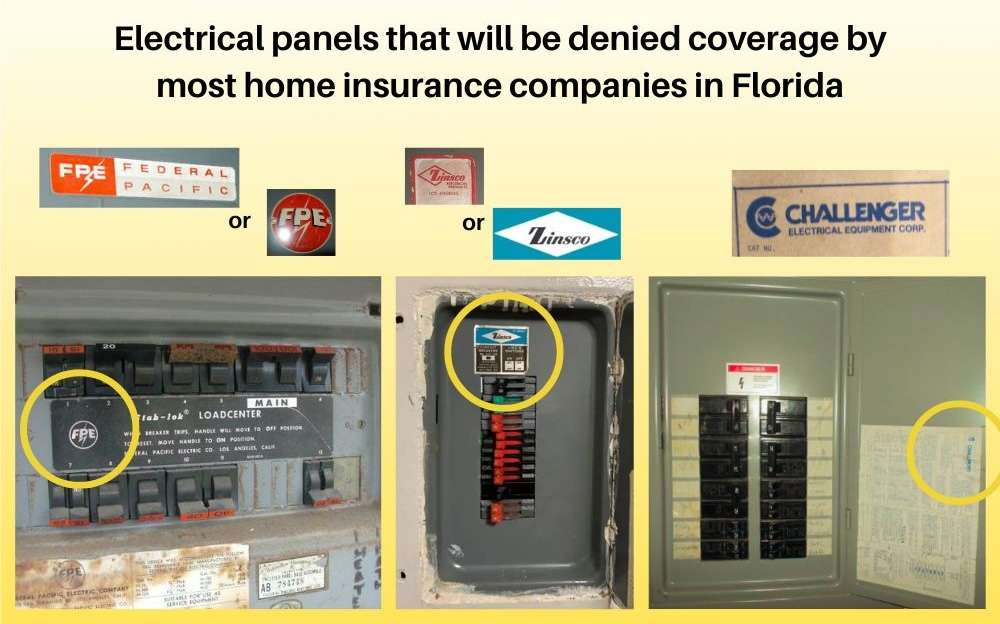
If your South Florida home was built between 1960 and 1990, which is most of the original housing stock in Hollywood, Pembroke Pines, Coral Springs, Plantation, Sunrise, Hialeah, and a lot of unincorporated Broward and Miami-Dade, open your panel and look for the manufacturer name on the inside of the door before reading further. Here’s the cheat sheet:
| Brand | Years Common | Core Problem | FL Insurance | Action |
|---|---|---|---|---|
| Federal Pacific / Stab-Lok | 1950–1980 | ~1 in 4 breakers fail to trip under overload; linked to ~2,800 fires/year | Almost always declined | Replace |
| Zinsco / Sylvania-Zinsco | 1960s–1970s | Breakers fuse to the bus bar; conduct power even when switched off | Almost always declined | Replace |
| Challenger | 1980s | Breakers fail to trip; connection points overheat (CPSC-documented) | Usually declined | Replace |
| Pushmatic / Bulldog | 1960s–1970s | Not GFCI/AFCI compatible; replacement parts scarce; mechanisms seize | Often flagged | Plan to replace |
| Fuse box (any) | pre-1960s | Undersized for modern load; no ground-fault or arc-fault protection | Disqualifier | Replace |
Federal Pacific Electric (FPE) / Stab-Lok
Federal Pacific Stab-Lok panels, installed in millions of U.S. homes between 1950 and 1980, fail to trip under overload conditions in roughly one of every four breakers tested, and are linked to an estimated 2,800 house fires per year nationally. The U.S. Consumer Product Safety Commission closed its formal investigation in 1983 without ordering a recall, but independent testing since has repeatedly confirmed the failure rate. No retrofit or repair makes them safe — the only fix is full panel replacement. (For background, the Federal Pacific Electric Corporation Wikipedia entry has a thorough history.)
Zinsco and Sylvania-Zinsco
Common in 1970s Florida construction. Zinsco panels have a design flaw where the breaker can melt to the aluminum bus bar inside the panel, fusing together. Once that happens, the breaker continues to conduct electricity even when switched to off, and it can no longer trip during an overload. You can’t tell from the outside that it’s failed. Sylvania-branded panels with Zinsco internals have the same problem.
Challenger
Manufactured through the 1980s, Challenger panels have breaker defects similar to Federal Pacific’s. The CPSC has a documented history of Challenger breakers failing to trip and connection points overheating. Many Challenger panels installed in South Florida homes from that era are still in service today.
Pushmatic / Bulldog Pushmatic
Pushmatic breakers don’t flip like modern breakers. You push a button to reset them, and there’s no obvious “off” position. They were common in 1960s and early 1970s South Florida homes. The breakers themselves aren’t recalled for fires the way FPE and Zinsco are, but they’re problematic for other reasons: replacement breakers are hard to find and expensive, they aren’t compatible with modern GFCI or AFCI protection, and they tend to seize up over time so they no longer trip when they should. If you have a Pushmatic, you’re due for an upgrade.
Any fuse box (pre-1960s)
If your home still has screw-in fuses instead of breakers, you’re working with technology from before central AC was standard in Florida. Fuse boxes don’t fail unsafely the way some old breaker panels do, but they’re undersized for any modern household, they have zero protection against ground faults or arc faults, and they almost guarantee an insurance issue. Replace it.
How Old Is Too Old?
Short answer: A modern panel can last 40–60 years, but in South Florida humidity, plan on an inspection at 20 years and replacement around 30–40, and sooner if the brand is one of the problem ones above.
- Under 20 years old: Likely fine. Have it inspected periodically and any time you add a major load (EV charger, pool heater, addition).
- 20 to 30 years old: Time for an inspection. Breakers wear out from thermal cycling, and South Florida’s humidity accelerates corrosion on the bus bars and connections inside the panel.
- 30 to 40 years old: Plan for replacement, especially if you’re adding load or your insurance is up for renewal. Many panels of this age also have known brand-specific defects.
- Over 40 years old, or any fuse box: Replace it. Period.
Capacity: Is Your Panel Big Enough?
Short answer: 200-amp service is the modern South Florida single-family standard. 60-amp fails inspection. 100-amp is borderline and usually inadequate once you add a second AC zone, a pool, or an EV charger.
Capacity is measured in amps, and you can usually find the rating on the main breaker at the top of the panel.
- 60-amp service: Almost certainly undersized. A 60-amp panel cannot safely support a modern South Florida home with central AC, electric water heater, electric range, dryer, pool equipment, and the dozens of plug loads in a typical household. Replace.
- 100-amp service: Borderline. It works for small homes with gas appliances and a single AC system, but it’s tight. If you’ve added square footage, a second AC zone, a pool, or an EV charger, you’ve probably outgrown it.
- 150-amp service: Adequate for most older single-family homes, but on the small side for newer builds with multiple AC zones, heated pools, EV chargers, or tankless electric water heaters.
- 200-amp service: The modern standard for most South Florida single-family homes. Comfortable headroom for current loads and future additions.
- 400-amp service: Larger homes, multiple AC zones, plus heated pool, plus EV charging, plus a workshop or guesthouse.
Why this matters in South Florida: Your AC alone can pull 30 to 50 amps when the compressor kicks on during summer. If your panel is already running close to capacity, every additional load (such as running the dryer while the AC is on, plugging in an EV, starting the pool pump) pushes you toward main breaker trips, voltage drops that damage appliances, and accelerated wear on the panel itself.
Warning Signs Your Panel or Breakers Are Failing
Even without a recalled brand, breakers and panels show signs of trouble before they fail. Any of these warrants a call to a licensed electrician:
- The same breaker trips repeatedly, especially when your AC starts or when you run multiple appliances at once.
- The panel cover or any individual breaker feels warm to the touch. A panel should never feel warm under normal load.
- Buzzing, humming, or crackling sounds coming from the panel. That’s usually a loose connection arcing inside.
- A burning plastic smell anywhere near the panel. Stop using the panel and call an electrician immediately.
- Visible rust, corrosion, or moisture inside the panel. South Florida humidity and any history of water intrusion corrodes the bus bars and connections.
- Discoloration, scorch marks, or melted plastic on breakers or the panel interior. Something has already overheated.
- Double-tapped breakers — two wires under one breaker terminal where only one is supposed to be. A common shortcut from prior unlicensed work, and a frequent reason a 4-point inspection fails.
- Lights dim or flicker when large appliances turn on, especially the AC. Significant flickering throughout the house often points to panel-level issues.
- A breaker won’t reset, or trips immediately every time you reset it. Hands off — call an electrician.
For more on related electrical red flags in South Florida homes, see our earlier guide on electrical issues every South Florida homeowner should watch for.
What Modern Panels Offer That Yours Probably Doesn’t
Even setting safety aside, modern electrical panels deliver real day-to-day benefits over equipment installed in the 1970s and 1980s:
- AFCI breakers (Arc Fault Circuit Interrupter) detect the tiny electrical arcs from damaged wiring or loose connections and cut power before an arc can ignite surrounding materials. The current 2023 Florida Building Code (8th Edition) requires AFCI protection in most habitable rooms in new construction.
- GFCI breakers add ground-fault protection at the panel level. Combined with point-of-use GFCI outlets in bathrooms, kitchens, garages, outdoors, and near pools, this is the modern Florida standard.
- Dual-function (CAFCI/GFCI) breakers combine both protections in a single breaker — common in current code-compliant installations.
- Whole-house surge protection can be installed at the panel to protect every device in the house from utility-side surges and lightning-related transients. Critical in South Florida, where afternoon thunderstorms are an everyday occurrence from June through October.
- Room for growth. A modern 200-amp panel has open slots for future circuits — an EV charger, a pool heater, a workshop subpanel, solar — without having to redo the panel again.
- Smart / energy-monitoring panels (Span, Leviton, Schneider Square D Energy Center, Eaton AbleEdge) are an optional upgrade that lets you see per-circuit energy use and control circuits from your phone. Useful if you’re planning solar or battery storage down the road.
What Panel Replacement Actually Involves
Short answer: One full day of work, often with FPL coordinating the temporary power shutoff, plus a final inspection by your city or county building department within about a week.
- Evaluation and estimate. An electrician inspects your existing panel, evaluates your home’s electrical load, and recommends the right amperage (typically 200-amp for a standard single-family upgrade).
- Permit application. Panel replacements require an electrical permit from your city or county building department. Florida law requires the homeowner to sign the permit application, and the homeowner needs to be present (or have an authorized adult present) for the final inspection. We pull the permit for you; you sign it.
- Power shutoff. The utility (FPL in most of South Florida) disconnects power at the meter so the work can be done safely. This is coordinated as part of the project.
- Panel removal and installation. The old panel comes out, the new panel goes in, every circuit is reconnected to the new breakers, and grounding and bonding are brought up to current code. Typical install is one full day.
- Power restoration and testing. The utility re-energizes the meter and the electrician tests every circuit before leaving.
- Final inspection. The building department inspector comes out (usually within a week) to verify the work meets code. The homeowner must be present to allow the inspector access. Once the inspection passes, the permit is closed out — and you have documentation for your insurance company.
Typical cost in South Florida (2026): A standard 200-amp panel replacement runs roughly $2,500 to $3,500. Factors that push the price up include relocating the panel, upgrading the service entrance cable from the meter, adding whole-house surge protection, repairing pre-existing wiring issues found during the work, or going to a 400-amp service. A 60-amp or 100-amp to 200-amp upgrade is usually toward the higher end because it also involves the meter and the utility connection.
Can You DIY Any of This?
No. And not just because we’d prefer you call us.
Florida law requires a licensed electrical contractor for any work inside the panel, on the service entrance, or that requires a permit. Working in an energized panel is genuinely dangerous — the lugs above the main breaker stay live even when the main is switched off, because they’re connected directly to the meter. People are killed every year doing exactly this kind of DIY work.
Beyond the safety risk, unpermitted electrical work creates problems when you sell the house, refinance, or file an insurance claim — and South Florida building departments are not shy about requiring open work to be brought to code retroactively, sometimes by tearing out finished walls. You can verify any Florida electrical contractor’s license at the Florida DBPR license lookup.
How Total Repair Pros Can Help
Electrical is one of Total Repair Pros’ four core trades — and we hold Florida license EC0001244. We handle electrical panel evaluations, full panel replacements, service upgrades from 60 or 100 amp up to 200 or 400 amp, AFCI/GFCI retrofits, and whole-house surge protection across Palm Beach, Broward, and Miami-Dade County.
- $0 trip charge for warranty members: panel inspections at no extra cost
- Licensed electricians on staff: no subcontractors, ever
- Permits pulled and inspections coordinated as part of every panel replacement — we walk you through the permit signing and inspection scheduling so nothing surprises you
- All four trades under one roof: if your panel inspection turns up an AC, plumbing, or appliance issue, we handle it.
- 55+ years in South Florida: we’ve been working on the wiring in these homes since they were built
If you have a Federal Pacific, Zinsco, Challenger, or Pushmatic panel, a 60- or 100-amp service, or any of the warning signs above, get it evaluated before it becomes an emergency (or an insurance problem). Learn more about our electrical panel replacement service, request a panel inspection online, or call 954-900-6767.
Frequently Asked Questions
Will my Florida home insurance cover replacing an old electrical panel?
Almost never. Standard Florida homeowners policies cover sudden, accidental damage from a covered peril (a lightning strike or fire damaging the panel, for example) — not wear, age, or pre-existing defects. Replacing a Federal Pacific, Zinsco, Challenger, or undersized panel for insurance compliance is treated as a homeowner-funded upgrade. The upside is that doing the upgrade can keep your existing policy from being non-renewed or denied at the next anniversary.
Which electrical panels do Florida insurance companies refuse to cover?
Federal Pacific (Stab-Lok), Zinsco, Sylvania-Zinsco, and Challenger panels are the four brands most commonly refused by Florida insurers. Pushmatic / Bulldog panels are frequently flagged. Pre-1960s fuse boxes are essentially uninsurable. 60-amp service is also typically rejected, and 100-amp service can be flagged depending on the carrier and the home’s electrical load.
How do I tell what brand of electrical panel I have?
Open the outer door of the panel (the gray metal box, usually in the garage or on the side of the house). Don’t touch anything inside — just look. The manufacturer name is printed on a label on the inside of the door, or on a sticker on the front of the breakers themselves. Common South Florida brands include Federal Pacific (FPE/Stab-Lok), Zinsco, Sylvania, Challenger, Pushmatic/Bulldog, GE, Square D, Eaton/Cutler-Hammer, and Siemens. The last four are modern and generally fine; the first five are problem brands worth replacing.
How much does a 200-amp panel replacement cost in South Florida?
As of 2026, a standard 200-amp panel replacement in South Florida typically runs $2,500 to $3,500. Service upgrades from 60 or 100 amp to 200 amp tend to be higher because they involve the meter and the utility connection. Add-ons like whole-house surge protection, panel relocation, or 400-amp service raise the price. Total Repair Pros provides free estimates for our electrical panel replacement service across Palm Beach, Broward, and Miami-Dade County.
My breaker keeps tripping. Do I need a new panel?
Not necessarily. A repeatedly tripping breaker can mean the circuit is overloaded (too much plugged into one circuit), the breaker itself is worn out, or there’s a short or ground fault on the circuit. An electrician can diagnose which it is in a single visit. If the breaker is the issue and your panel brand is fine, swapping the breaker is a quick fix. If multiple breakers are aging out at once, or if your panel is a recalled brand, replacement is the better path.
Do I need a permit to replace my electrical panel in Florida?
Yes. Panel replacements require an electrical permit from the city or county building department where your home is located. By Florida law, the homeowner must sign the permit application and be present at the home (or have an authorized adult present) for the final inspection. A licensed electrical contractor handles the rest, including pulling the permit, scheduling the inspection, and ensuring the work passes.
How long does a panel replacement take?
The physical work is typically one full day. Power is off during the install, which is coordinated with FPL. The final inspection by the building department usually happens within a week of the install, depending on the city’s inspector schedule. The permit closes out once the inspection passes.
Is Federal Pacific actually banned?
No. Federal Pacific Electric panels were never formally recalled. The U.S. Consumer Product Safety Commission closed its investigation in 1983 without ordering a recall, citing the resources required to prove the defects in litigation. Independent testing since then has repeatedly found high breaker failure rates, and most Florida insurers now treat the panels as uninsurable regardless of the CPSC’s non-action.
About the author: Ashley Southard is the operations manager at Total Repair Pros, a family-owned home services company that has been serving South Florida since 1970. Total Repair Pros holds Florida licenses CMC1250406 (HVAC), CFC1432410 (plumbing), and EC0001244 (electrical).